Every voice agent platform has a headline price, and it is never the price. "$0.05 a minute" turns out to be the platform's own fee, with the phone line, the speech recognition, the model and the voice billed on top. By the time a founder has added it all up, the number has doubled and they have stopped trusting any of it.
I have spent the last few years on the phone side of this. At Acefone I work on an agent inbox where voice calls, WhatsApp calls and chats meet, including the first WhatsApp IVR in Asia, and a large part of that job is knowing what a minute of a call actually costs and where it goes. So here is a minute of an AI phone call, taken apart, with list prices from each provider's own page as of September 2026.
One minute, part by part
A voice agent is four meters running at once. The phone line bills for the whole call. Speech-to-text bills for every minute of audio you stream to it, silence included. The model bills per token, every time the agent decides what to say. The voice bills per character it speaks.
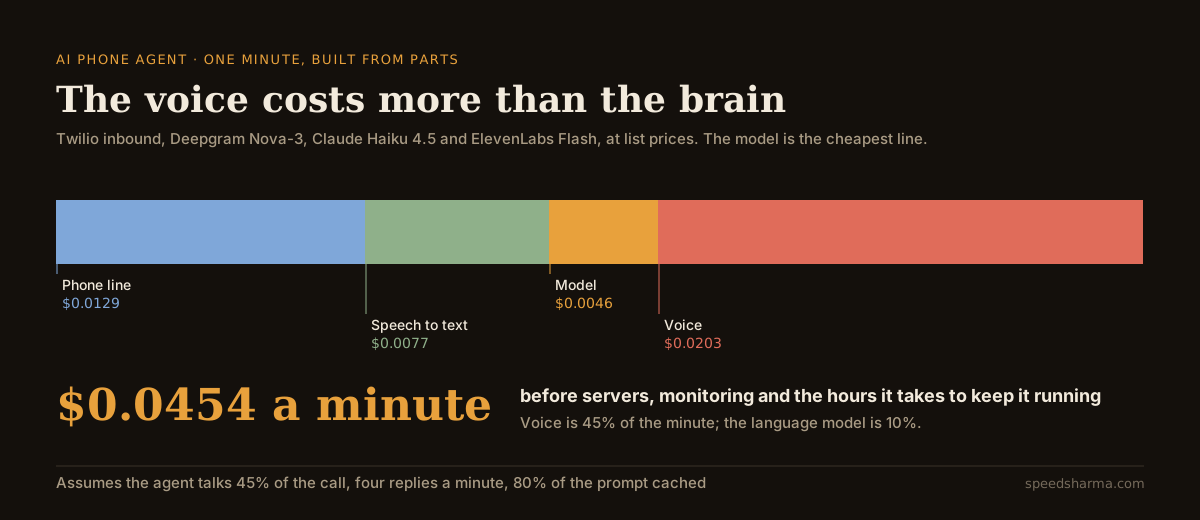
Here is where each number comes from. These are list prices, not the promotional rates several providers are running.
| Part | Price | Per minute of call |
|---|---|---|
| Twilio US inbound, local number, plus Media Streams | $0.0085 + $0.0044 a minute | $0.0129 |
| Deepgram Nova-3 streaming | $0.0077 a minute (promo $0.0048) | $0.0077 |
| Claude Haiku 4.5 | $1 in, $0.10 cached, $5 out per 1M tokens | $0.0046 |
| ElevenLabs Flash voice | $0.05 per 1,000 characters | $0.0203 |
| Total | $0.0454 |
Two of those rows need their working shown.
The model. An agent reply is one model call. Assume four replies a minute, a 3,000-token prompt each time (instructions, tool definitions and the conversation so far), 60 tokens out, and 80% of the prompt served from cache because the instructions do not change between turns. That is about $0.0011 a reply, or $0.0046 a minute.
The voice. People speak at roughly 150 words a minute. If the agent talks for 45% of the call, that is about 68 words, or around 400 characters. At $0.05 per 1,000 characters, the voice costs $0.020 a minute, more than the phone line and the model put together.
quick check
In a typical voice agent stack, which part costs the most per minute?
A good voice runs about $0.02 a minute because it is billed per character spoken. A small model with prompt caching costs a quarter of that. Upgrading the model is cheaper than most people expect; the voice is where the money goes.
The model is cheaper than you think
This is the part that surprises people. Here is what happens to that same minute when only the model changes.
| Model | Model cost a minute | Whole minute |
|---|---|---|
| GPT-5.6 Luna | $0.0010 | $0.0418 |
| Claude Haiku 4.5 | $0.0046 | $0.0454 |
| Claude Opus 5 | $0.0228 | $0.0637 |
| GPT-6 Astra | $0.0456 | $0.0865 |
Going from a small model to one of the most capable models available adds about two cents a minute. Whether that is worth it depends on what the agent does: booking appointments rarely needs it, and handling an angry customer with a refund policy might. But it is not the line that makes voice agents expensive.
What does move the model cost is caching. Turn it off and the Haiku line goes from $0.0046 to $0.0132 a minute, nearly triple, because the same instructions get re-billed at full price on every reply. If your provider supports prompt caching and your framework is not using it, fix that before anything else.
The voice is where the money is
Swap only the voice and keep everything else the same:
- ElevenLabs Flash at $0.05 per 1,000 characters: $0.0203 a minute
- Cartesia on its Startup plan, about $0.039 per 1,000: roughly $0.016
- Deepgram Aura-2 at $0.030 per 1,000: $0.0122
- OpenAI tts-1 at $0.015 per 1,000: $0.0061
Moving from ElevenLabs Flash to OpenAI tts-1 cuts the whole minute by about 30%. That is a real saving, and it is also a real product decision, because the voice is what the caller actually hears. My advice is to pick the voice by listening to it on your own script, then price it, not the other way round. Callers forgive a slightly slower answer more readily than a voice that sounds wrong.
The platforms
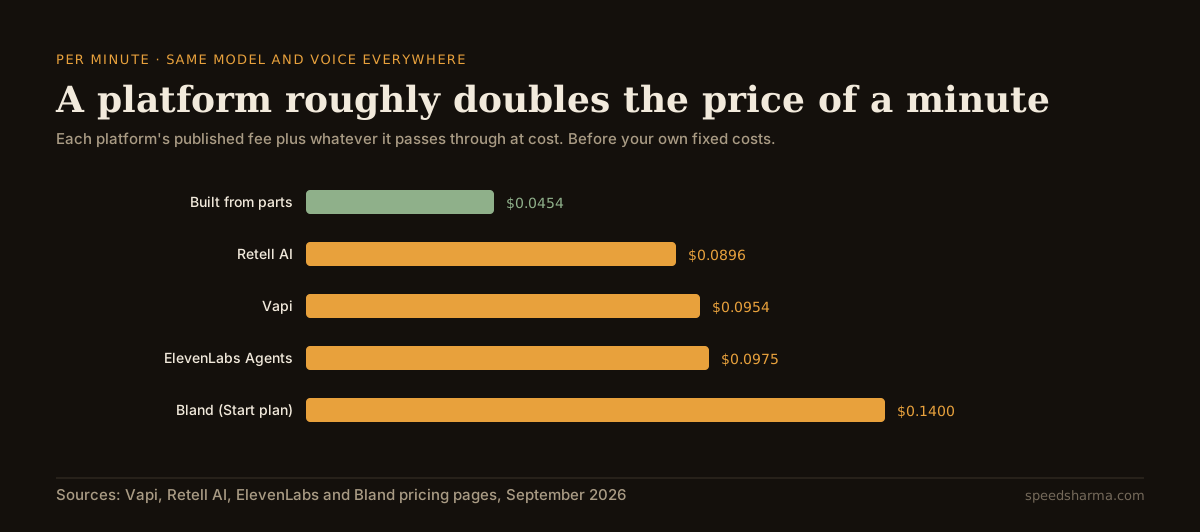
Hosted platforms handle the plumbing: telephony, streaming, turn-taking, interruptions, and the dashboard. What they charge on top, from their own pricing pages:
| Platform | Their fee | What they add on top |
|---|---|---|
| Vapi | $0.05 a minute | every component at cost; 10 concurrent lines included, then $10 a line a month |
| Retell AI | $0.055 infrastructure + $0.015 US telephony + $0.015 voice | the model, $0.003 to $0.16 a minute depending on which |
| ElevenLabs Agents | $0.08 a minute beyond plan minutes | the model and the phone line |
| Bland | $0.14 a minute on Start, or $0.12 plus $299 a month on Build | nothing; model and speech are included |
Put the same model and voice through each and they land close together.
Work out your own minute
Change the parts, the volume and the assumptions. The defaults are the stack above at 20,000 minutes a month.
calculator · list prices, checked 12 Sep 2026
What one minute of an AI phone call costs
one minute, built from parts
per minute, same model and voice everywhere
Platform prices are their published per-minute fees plus whatever they pass through at cost: Vapi bills every component on top, ElevenLabs Agents bills the model and phone line on top, Retell's figure includes its voice infrastructure, phone line and standard voices, and Bland's Start plan is all-in. Several model and speech prices are introductory. Sources are linked in the post.
Build or rent
Half the per-minute price sounds like an easy decision until you count what a platform is doing for its fee. Running your own pipeline means servers, monitoring, someone on call when a carrier changes something at 2am, and a steady trickle of maintenance. The calculator puts that at $800 a month by default: a few small servers plus around eight hours of an engineer's time at the $61 to $80 an hour Arc.dev lists as the median for back-end freelancers. Change it to whatever your own team costs.
With that fixed cost in, the answer depends almost entirely on volume.
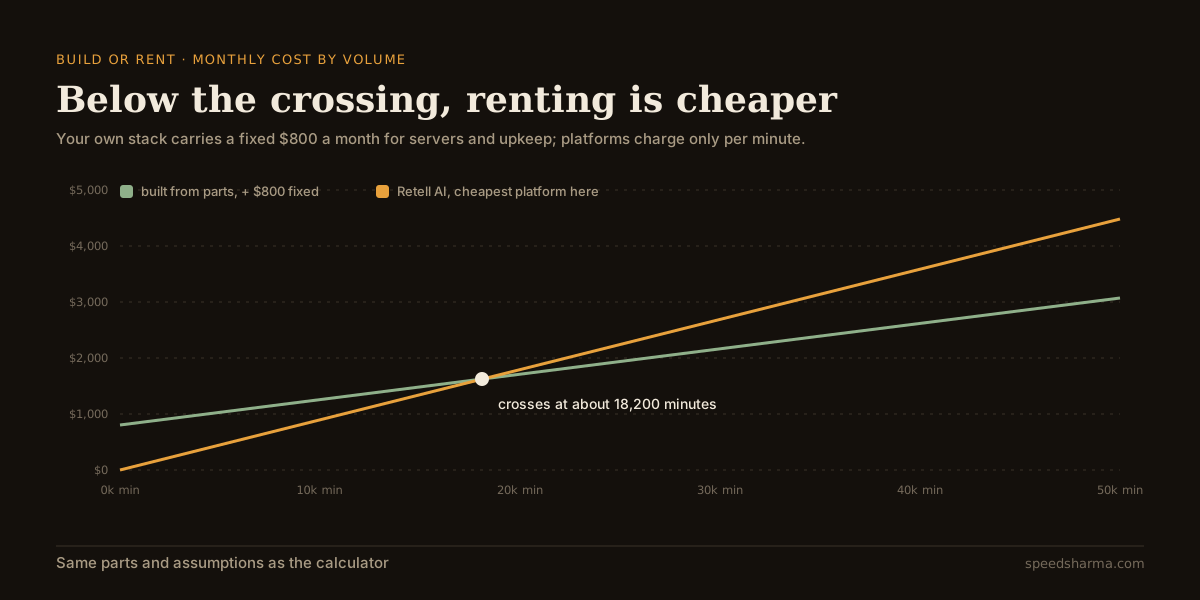
| Minutes a month | Built from parts | Cheapest platform |
|---|---|---|
| 5,000 | $1,027 | $448, Retell AI |
| 20,000 | $1,708 | $1,791, Retell AI |
| 100,000 | $5,341 | $8,956, Retell AI |
| 100,000, cheaper parts | $3,651 | $7,851, Vapi |
The last row swaps in AssemblyAI for speech-to-text, Deepgram Aura-2 for the voice and GPT-5.6 Luna for the model. At that volume the saving is over $4,000 a month, which is enough to pay for the engineer who runs it.
For most teams the sensible path is to start on a platform, learn what your calls actually look like, and move to your own pipeline once volume passes the crossing and the call flow has stopped changing every week.
What the per-minute number leaves out
- Silence is billed. Speech-to-text providers bill for the audio you stream, and AssemblyAI says explicitly that billing runs for as long as the connection is open. A call with long pauses costs the same as a busy one.
- Concurrency. Vapi includes ten simultaneous calls and charges $10 a month for each line after that. A campaign that dials 200 people at once changes the maths.
- Promotional prices. Deepgram's current rate is a limited-time promotion with no end date given, and Google's Gemini Flash prices double on 1 January 2027. Budget on list prices.
- Latency. The cheapest parts are not always the fastest, and a voice agent that takes too long to answer loses the caller whatever it costs. That trade-off has its own post: the latency budget of a voice agent.
- Speech-to-speech models. OpenAI's Realtime API prices audio by the token, $32 per million in and $64 per million out, and does not publish a per-minute figure, so it is not in the calculator.
questions people ask
How much does an AI voice agent cost per minute?
Built from parts at list prices, about $0.03 to $0.09 a minute depending on the model and voice, with $0.045 typical. On a hosted platform, roughly $0.09 to $0.14 a minute for the same parts.
Is Vapi really $0.05 a minute?
That is Vapi's own platform fee. The phone line, speech-to-text, model and voice are billed on top at cost, so a typical call lands nearer $0.09 to $0.10 a minute.
What is the most expensive part of a voice agent?
Usually the voice. Text-to-speech is billed per character spoken, and a natural-sounding voice costs around $0.02 a minute, more than a small language model and the phone line combined.
When is it cheaper to build my own voice agent?
Once you pass roughly 16,000 to 21,000 minutes a month, if running it yourself costs around $800 a month. Below that, a platform's fee is cheaper than your own upkeep.
Does using a smarter model make calls much more expensive?
Less than you would expect. Moving from Claude Haiku 4.5 to Claude Opus 5 adds about 1.8 cents a minute with prompt caching on.
The short version
A minute of an AI phone call costs about four and a half cents to build and nine to fourteen cents to rent. The voice is the biggest line and the model one of the smallest, so spend your optimisation effort on caching and on choosing a voice you can afford, not on shaving the model.
Rent while you are small and the flow is still changing. Build once you are past the crossing and know what your calls look like. And if the same customers also reach you on WhatsApp, the per-message side of that bill changes on 1 October.