You have a budget, a deadline and a product that needs building or rescuing. Four kinds of people will offer to help: a freelancer, an agency, a fractional CTO, and a full-time employee you have not hired yet. Every comparison of these options you will find online was written by one of the four.
So here is the disclosure up front: I am one of them. I take freelance work, so treat my opinion on freelancers as an interested one. What I can do is show the published rate cards, put the same budget and deadline through the same model, and be specific about how each option fails, mine included.
The short answer is that the four are not substitutes. Two of them sell hours, one sells parallel capacity with a management layer on top, and one sells decisions. Comparing them on hourly rate alone is the mistake that makes founders overpay in both directions.
What each one is actually for
A freelancer is a pair of experienced hands with no layer between you and the work. They are quick to start, cheap relative to an agency, and they will tell you when your idea is more expensive than you think. They are also one person, which is the whole risk in a sentence.
An agency sells capacity. The reason to pay their rate is that they can put three or four people on your project next month, along with design, QA and someone whose job is to chase the work. You are paying for the ability to parallelise and for not having to run the team yourself.
A fractional CTO sells judgement, a day or two a week. What to build, what to stop building, which architecture will survive the next year, who to hire and how to interview them. They are the right purchase when the problem is that nobody senior is deciding, and the wrong one when the problem is that nobody is building.
A full-time hire is the only option that accumulates context. Everything they learn about your product stays in the company, and the cost per hour is lower than any rate card. You pay for that with two months of hiring, a month of ramp, and the risk that the person is wrong for you.
What they cost: the published rates
These are published bands, not my prices.
| Who | Rate | Source |
|---|---|---|
| Agency in India | $25–49/hr | Clutch, September 2026 |
| Agency in the US | $50–99/hr | Clutch |
| Agency in Canada or Australia | $100–149/hr | Clutch |
| Senior back-end freelancer | $61–80/hr | Arc.dev median band |
| Fractional CTO, Europe | €120–280/hr | fractional-csuite.com |
| Full-time back-end, global median | $79,742/yr | Stack Overflow 2025 |
| Full-time back-end, United States | $175,000/yr | Stack Overflow 2025 |
To compare a salary with a rate card you have to load it. The US Bureau of Labor Statistics puts wages and salaries at 70.0% of employer costs for private industry workers in June 2026, with benefits making up the other 30%, so a salary costs roughly 43% more than the number on the offer letter. Spread that over a 1,760-hour working year, which is the convention the fractional rate card uses, and the global median back-end salary becomes about $65 an hour. The US median becomes about $142.
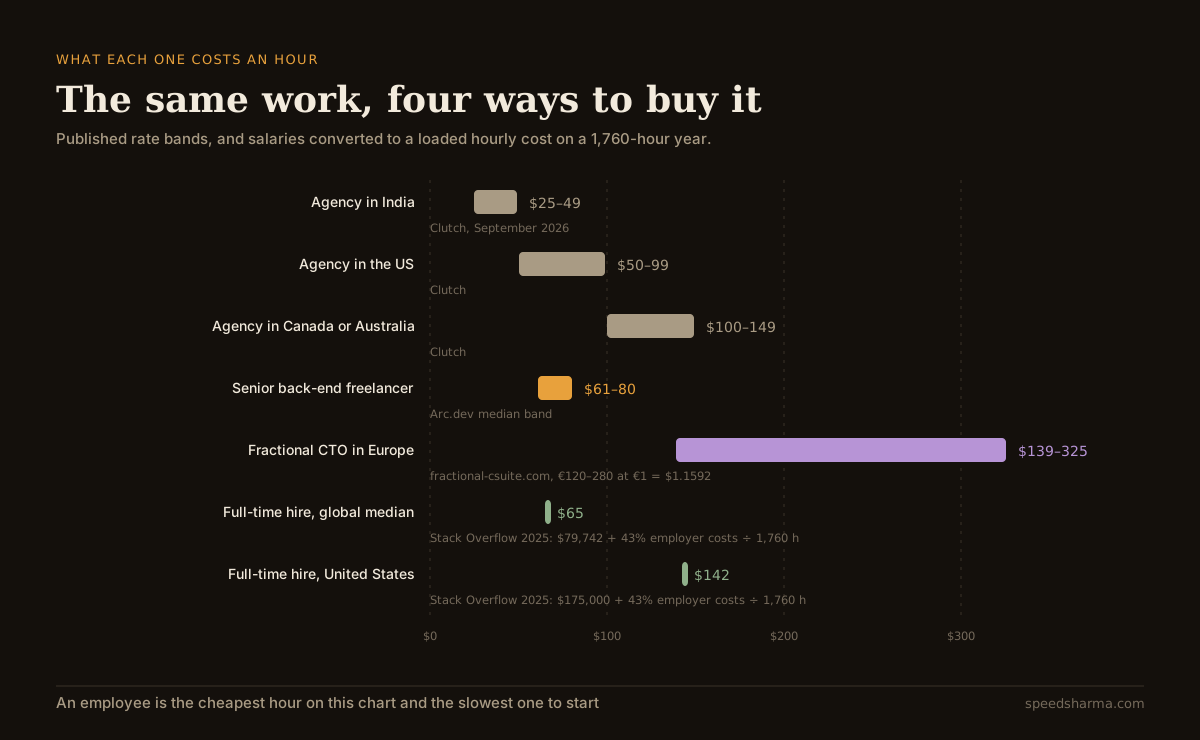
Notice that the ranking flips depending on where you are hiring. In the US, an employee costs about as much per hour as a domestic agency, and a freelancer working from elsewhere is cheaper than both. That is the arbitrage the whole outsourcing industry sits on, and it is also why the same brief can produce a $30,000 quote and a $150,000 quote without either being dishonest. I took the same view when scoping what a chatbot build costs: the hours are the hours, and the rate is a separate decision.
Six months and $120,000
Rates are not the comparison. What matters is how many hours of actual building reach your product before the deadline, and what you had to pay to get them. The model below takes four things off the top of every option: time before work starts, a ramp at half output, the share of billed time that is management rather than building, and a discount for the way each arrangement usually fails.
| Option | Hours it can absorb a month | Before work starts | Ramp | Share of time building | Risk discount |
|---|---|---|---|---|---|
| Senior freelancer | 140 | about a week | a week | 95% | 20% |
| Agency | 520 | about two weeks | two weeks | 80% | 15% |
| Fractional CTO | 60 | about a week | none | 35% | 10% |
| Full-time hire | 147 | two months | a month | 90% | 25% |
Those capacity, ramp and risk numbers are my assumptions, not published figures, and they are the part of this worth arguing with. The risk discount is the probability-weighted cost of the usual failure: a freelancer disappearing, an agency swapping your senior for a junior, a fractional CTO being pulled into another client, a new hire leaving or turning out to be wrong for the job. Change them in the tool and the answer changes.
calculator · what a fixed budget and deadline really buy
Freelancer, agency, fractional CTO or a hire
the job
the rates
risk-adjusted build hours delivered in the time you have
what each one is actually for
Rates are published bands: Clutch for agencies, Arc.dev for back-end freelancers, fractional-csuite.com for fractional CTOs converted at the ECB reference rate, and the Stack Overflow 2025 survey for salaries, loaded using the US Bureau of Labor Statistics split where benefits are 30% of total compensation. Capacity, ramp time and the risk discounts are my assumptions and are listed in the post. You pay for ramp time as well as productive time, which is why an employee's cost per delivered hour falls the longer they stay. Build hours are what reaches the product, so an option that spends its time on decisions rather than code scores low here by design.
On the defaults, six months and $120,000 produce four quite different outcomes. The agency delivers the most build hours, about 883, and spends the whole budget to do it, which works out at $136 per delivered hour. The freelancer delivers about 509 hours at $111 each, the most efficient conversion of money into work, but spends only $56,350 because one person cannot absorb more in six months. The full-time hire delivers about 295 hours at $129 each, held back by two months of hiring and a month of ramp. The fractional CTO delivers about 92 build hours at $859 each, which tells you plainly that build hours are not what you are buying.
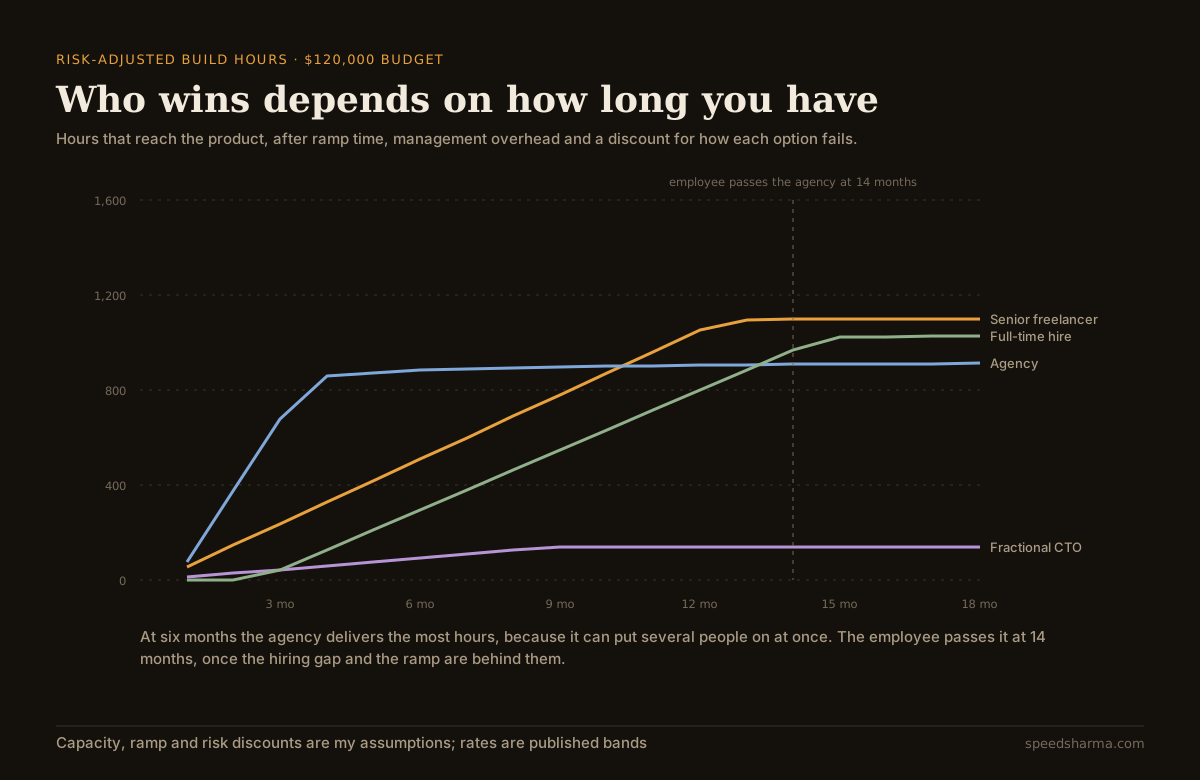
The shape of that chart is the argument. An agency buys you speed now at a premium. An employee buys you hours later at the lowest price, and their cost per delivered hour keeps falling as the hiring and ramp are amortised: about $129 an hour over six months, about $116 over two years. A freelancer sits between the two and is limited by being one person.
Cost per hour is not cost per project
Three traps follow from that.
The first is picking on hourly rate. The agency has the worst rate per delivered hour here and still delivers the most work in the time available, because it can put more people on the problem. If your deadline is the binding constraint, paying more per hour is rational.
The second is assuming the budget will be spent. One freelancer at $70 an hour cannot consume $120,000 in six months; roughly $63,650 of that budget goes unspent. The choice is not "freelancer or agency at the same cost". It is "spend half the budget and take longer, or spend all of it and go faster".
The third is ignoring your own time. Every option needs briefing, reviewing and deciding, and that time comes from whoever is running the company. Fifteen per cent of their output is a conservative allowance. With a vague brief it is far higher, and this is precisely where a fractional CTO earns their fee: they absorb that load instead of adding to it.
quick check
You have $120,000 and six months. Which option delivers the most build hours, on the assumptions in this post?
The agency absorbs the whole budget inside the deadline, delivering about 883 hours. The freelancer is more efficient per hour but capped by being one person, and the employee loses three of the six months to hiring and ramp.
How each one fails
An even-handed comparison is mostly a list of failure modes.
The freelancer, including me. One person is one point of failure: illness, a better offer, or simply going quiet. There is no cover, no second opinion inside the engagement, and a hard ceiling on hours. You also become the project manager by default. The honest mitigations are a scoped, fixed-price phase rather than an open-ended hourly arrangement, written handover documentation from the start rather than the end, and someone on your side who can read the code. When I built EMPRO alone in six months, the whole architecture was chosen so that someone who was not me could run it afterwards, and my one regret is writing the handover notes in week twenty instead of week one.
The agency. The people who sell the work are rarely the people who do it, so ask who specifically will be on your project and what else they are on. Knowledge leaves when the contract ends, which is why the handover terms matter more than the hourly rate. Watch the change-request mechanism: a fixed-price quote against a vague specification is a negotiation waiting to happen. And make sure the code, the repositories and the cloud accounts are in your company's name from day one.
The fractional CTO. They are split across several companies, so the response time is what it is, and they cannot ship the work themselves. If you hire one hoping the product will get built, you will spend a lot and get architecture diagrams. They are worth it when the expensive mistakes are decisions rather than code.
The full-time hire. The cost is not the salary; it is the two months before they start, the month before they are useful, and the risk of hiring the wrong person, which costs the whole period. Hiring is also a skill, and a first-time founder hiring their first engineer without help usually pays for that education once. The upside is real, though: at TRIBE I led three developers through two years of building, and almost everything valuable we learned about the market lived in those people rather than in any document.
The two that get confused
Founders most often hesitate between a senior freelancer and a fractional CTO, because both are one experienced person on a part-time basis. They are not the same purchase.
| A senior freelancer | A fractional CTO |
|---|---|
| Paid to build the thing | Paid to decide what gets built |
| Measured in shipped work | Measured in decisions and hires that stick |
| Right when the plan is clear | Right when the plan is the problem |
| Ceiling is their hours | Ceiling is their attention |
| Leaves behind a system | Leaves behind a team and a direction |
If you can write a clear brief with an outcome, buy building. If you cannot, buying more building hours will make things worse, not better, and the cheapest hour you can buy is the one that stops the wrong project.
What I take, and what I do not
Since this post exists partly because founders ask me which of the four they need, here is my own position, so you can discount it appropriately.
I sell fixed-price scoped phases rather than hourly work, because hourly billing rewards the wrong thing and makes the budget unpredictable for you. I do two-week architecture reviews with a written report and a walkthrough call, with no obligation to hire me for whatever the report recommends. What I am not a fit for: hourly staff augmentation, a brief that amounts to "make it like Uber", and full-time on-site work. If what you need is four people next month, an agency is a better answer than I am, and I will say so.
questions people ask
Should I hire a freelancer or an agency?
A freelancer is usually better value per hour and quicker to start, and suits a focused scope where one experienced person is enough. An agency suits work that has to happen in parallel or by a hard deadline, and brings design, QA and project management you would otherwise run yourself.
What does a fractional CTO cost?
Published European rates are €120–280 an hour, which is roughly $139–325, typically at one to three days a week over six to twelve months. The cost of a day a week for six months is comparable to a small build project, which is why it only makes sense when decisions rather than delivery are the bottleneck.
Is a fractional CTO worth it for a startup?
Worth it when the expensive mistakes are architectural or organisational: choosing a stack, structuring a team, deciding what not to build. Not worth it when you already know what to build and simply need it built, because very little of their time reaches the code.
Is it cheaper to hire a developer or use an agency?
Per hour, an employee is far cheaper. Loading the global median back-end salary of $79,742 with employer costs gives about $65 an hour, against $50–99 for a US agency. The catch is that hiring takes months and the salary continues whether or not there is work.
How much does a full-time developer really cost?
Take the salary and add roughly 43% for employer costs, since US data puts wages at 70% of total employer costs. Then add recruitment, equipment, and the two to three months before the person is fully productive.
How much of my own time will this take?
Plan for at least 15% of whatever they produce, spent on briefing, reviewing and deciding. A vague brief pushes that much higher, and it is the most commonly forgotten cost in every one of these options.
The short version
Compare these four on delivered hours and on how each fails, not on hourly rate. An employee is the cheapest hour and the slowest to arrive. An agency is the most expensive hour and the fastest way to put several people on a deadline. A freelancer converts money into work most efficiently and cannot scale past one person. A fractional CTO barely registers on build hours because that is not what they sell.
Then match the option to the shape of your problem. If the plan is clear and the scope is focused, buy building. If the deadline is immovable and the work parallelises, buy capacity. If you will still be building this in two years, start hiring now and accept the slow first quarter. And if you cannot write the brief, buy the decision first, because no amount of cheap hours will save a project that is aimed at the wrong thing.