Most LLM cost calculators answer the question "what does one request cost?". It is the wrong question for anyone setting a price. A request costs a cent, a cent sounds like nothing, and six months later the AI feature is losing money on exactly the customers who love it most.
The question that decides whether an AI feature is a business is "what does one user cost in a month?". Getting from one to the other takes four multiplications, and every one of them is bigger than it looks in a spreadsheet.
I build this kind of feature, and I contribute to litellm, the open-source gateway a lot of teams put in front of their model providers to track exactly this. This post is the arithmetic, with September 2026 list prices and a calculator you can point at your own plan.
From tokens to a user's month
Here is a mid-sized AI feature, the kind that answers questions over a company's own documents. Each call sends about 6,000 tokens (instructions, retrieved passages, the conversation so far) and gets 500 back. Each thing a user does takes three calls: one to plan, one to look something up, one to answer. A typical user does that 150 times a month.
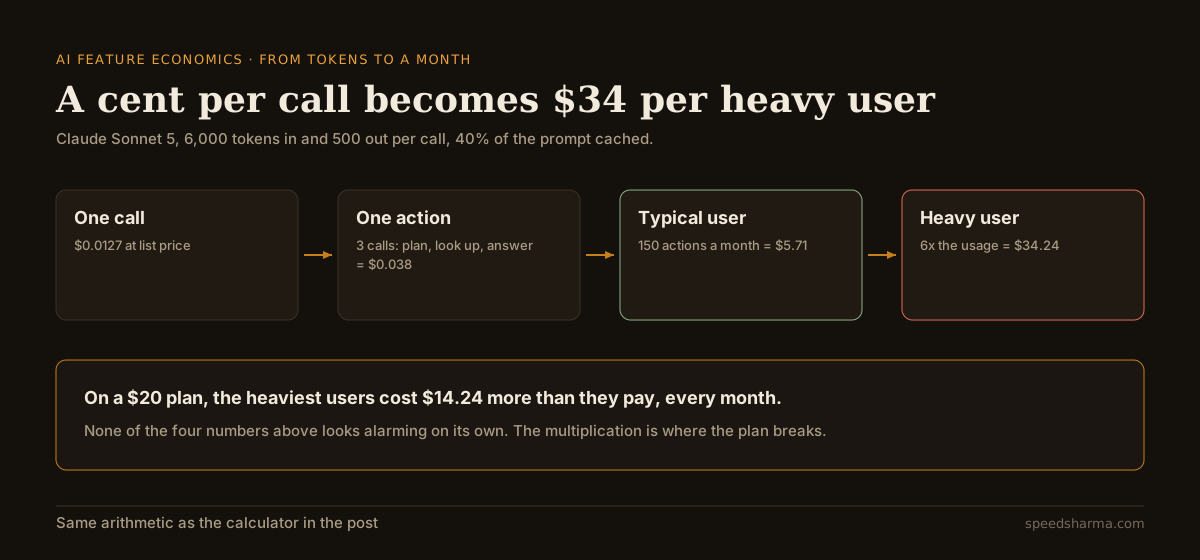
On Claude Sonnet 5, with 40% of the prompt served from cache, that call costs about $0.0127. Three of them make an action worth $0.038. A typical user's month is $5.71, which is fine on a $20 plan. The trouble is the users who are not typical.
The users who are not typical
Usage in AI products is lopsided. A small group of people build the product into their daily work and use it far more than everyone else. If 10% of users run at six times the typical rate, each of them costs $34.24 a month. On a $20 plan, every one of those customers loses you $14.24 a month, and they are the customers most likely to recommend you.
Averaged across everyone, model costs come to $8.56 per user, 43% of revenue. That is before hosting, embeddings, support, and the salaries of the people who built it.
Three things make this worse than it first appears:
- Heavy users are sticky. They are the last to churn, so their share of your user base grows over time.
- They find the expensive paths. Long documents, big exports, long agent runs. Their tokens per call are higher, not just their call counts.
- Unlimited plans invite them. "Unlimited" is a promise about the one number you do not control.
Agents multiply calls
The number that moves fastest in modern AI features is calls per action. A chat reply is one call. An agent that plans, uses a tool, checks its work and then answers is four or five. Every extra step sends the whole context again.
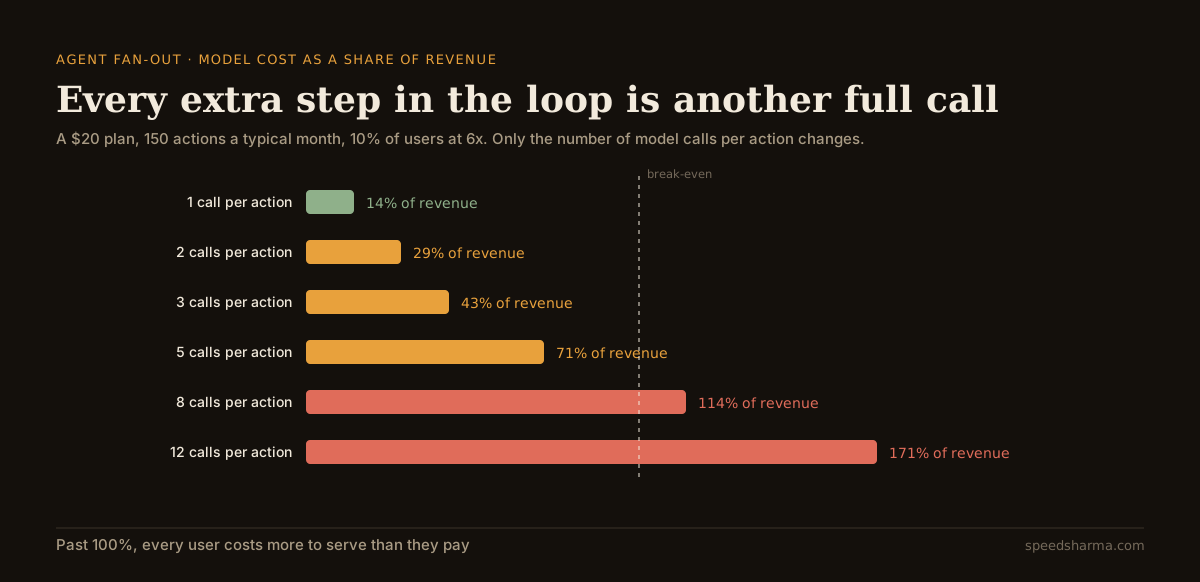
This is why an agent feature that looked profitable in a prototype can turn underwater after a sprint that "just added a verification step". Nobody changed the price or the model. The loop got one step longer.
quick check
Your feature makes three model calls per action and model costs are 43% of revenue. You add a planning step and a verification step, so it makes five. Nothing else changes. Roughly what share of revenue do model costs take now?
Each call resends the full context, so cost scales with the number of calls. Five calls instead of three is 5/3 of the cost: 43% times 1.67 is about 71%.
Model prices, September 2026
List prices per million tokens, from each provider's own pricing page. "Cached" is the price of input served from the provider's prompt cache.
| Model | Input | Cached input | Output |
|---|---|---|---|
| Claude Opus 5 | $5.00 | $0.50 | $25.00 |
| Claude Sonnet 5 | $2.00 | $0.20 | $10.00 |
| Claude Haiku 4.5 | $1.00 | $0.10 | $5.00 |
| GPT-6 Astra | $10.00 | $1.00 | $50.00 |
| GPT-5.6 Terra | $2.00 | $0.20 | $12.00 |
| GPT-5.4 mini | $0.75 | $0.075 | $4.50 |
| GPT-5.6 Luna | $0.20 | $0.02 | $1.20 |
| Gemini 3.1 Pro (preview, up to 200K) | $2.00 | $0.20 | $12.00 |
| Gemini 3.8 Flash (introductory) | $0.75 | $0.075 | $3.75 |
| DeepSeek Flash (peak hours) | $0.30 | $0.006 | $1.20 |
| Mistral Small 4 | $0.15 | — | $0.60 |
Three footnotes that change real bills:
- Tokenizers differ. Anthropic notes that its newer models use a tokenizer that produces about 30% more tokens for the same text. Compare models on the cost of doing your task, not on the price per token.
- Introductory prices end. Google's Flash prices run "through December 31, 2026", then double to $1.50 in and $7.50 out. On the example above, Gemini 3.8 Flash goes from 16% of revenue to 32% overnight. OpenAI's GPT-5.6 Sol pricing is also marked promotional.
- Long prompts cost more on some models. GPT-6 Astra charges double for input on prompts over 272,000 tokens, and Gemini 3.1 Pro has a higher rate above 200,000.
Work out your own feature
Put in your own price, usage and prompt sizes. The defaults are the document-assistant example above.
calculator · list prices per 1M tokens, checked 12 Sep 2026
What your AI feature costs per user
monthly model cost against what each user pays
Counts model tokens only: not embeddings, vector storage, hosting, or the evals you should be running. Cached input is priced at each provider's cache-read rate; cache writes and batch discounts are left out. Several prices are introductory.
The same feature, priced nine ways
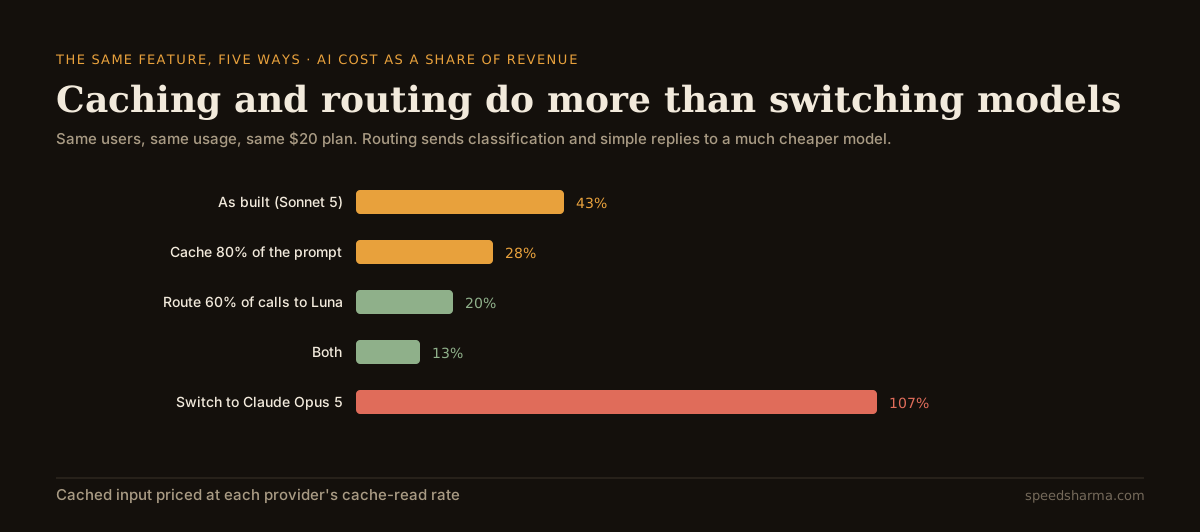
Everything below uses the same 1,000 users, the same usage and the same $20 plan. Only the model, caching, routing or fan-out changes.
| Change | Typical user | Heavy user | Model cost, share of revenue |
|---|---|---|---|
| As built, Claude Sonnet 5 | $5.71 | $34.24 | 43% |
| Cache 80% of the prompt | $3.76 | $22.57 | 28% |
| Route 60% of calls to GPT-5.6 Luna | $2.65 | $15.91 | 20% |
| Cache 80% and route 60% | $1.76 | $10.55 | 13% |
| Switch to Gemini 3.8 Flash (intro price) | $2.14 | $12.84 | 16% |
| Switch to Claude Opus 5 | $14.26 | $85.59 | 107% |
| Switch to GPT-6 Astra | $28.53 | $171.18 | 214% |
| Agent with 12 calls per action | $22.82 | $136.94 | 171% |
| Simple chat, one call, Claude Haiku 4.5 | $0.42 | $2.50 | 3% |
The pattern is consistent. The biggest wins come from how the feature calls the model, not from which model it calls.
Five levers, in the order I would pull them
- Cache the stable prefix. Instructions, tool definitions and long reference material rarely change between calls. Put them first in the prompt, mark them for caching, and they are billed at a tenth of the input price on most providers. It is usually an afternoon of work.
- Route the easy calls. Classifying a request, extracting fields, deciding which tool to use: these rarely need a frontier model. A gateway that sends them to a small model and saves the big one for the final answer cut this example's cost by more than half.
- Cap the loop. Give every agent a maximum number of steps and a token budget per task. An agent that retries itself into a twelve-call loop is not being thorough; it is spending your margin.
- Price for the heavy tail. Usage limits on the base plan, a higher tier for power users, or credits that roll over. Pick one before launch, because adding limits later reads as taking something away.
- Batch what can wait. Anthropic and OpenAI both take 50% off for batch jobs. Nightly summaries, report generation and backfills do not need an answer in two seconds.
Then measure. Log tokens, cached tokens and model per call, tagged with the user and the feature. Without that, you are pricing from the prototype's numbers, and the cost will surface in production before the dashboard does.
questions people ask
How much does an LLM cost per user?
It depends on tokens per call, calls per action and actions per month. A simple chat feature on a small model can cost well under $1 a user each month; an agent feature on a mid-sized model can cost $5 to $25 for a typical user and several times that for heavy users.
How do I calculate the cost of one LLM request?
Multiply input tokens by the input price and output tokens by the output price, each per million tokens, and add them. If part of the prompt is cached, price that part at the cached-input rate.
Is prompt caching worth it?
Almost always. Cached input costs a tenth of the normal input price on Anthropic's and OpenAI's current models. In the example above, caching 80% of the prompt instead of 40% cut model costs by about a third.
What is the cheapest capable model in 2026?
At list price, GPT-5.6 Luna ($0.20 in, $1.20 out per million tokens), DeepSeek Flash and Mistral Small 4 are among the cheapest. Which one is capable enough depends on the task, so test on your own examples before switching.
Why is my LLM bill higher than my estimate?
Usually one of three things: more calls per action than planned, larger prompts than planned because of retrieved context and history, or a few heavy users. Log all three per user to find out which.
The short version
Price an AI feature per user, not per request. Multiply tokens per call by calls per action by actions per month, then look at your heaviest tenth of users separately, because they decide whether the plan works.
If the number is too high, cache the stable part of the prompt, route easy calls to a small model, and cap how many steps an agent can take, in that order. Switching to a cheaper flagship helps less than any of those.
The same arithmetic runs per minute on a phone line, where the model turns out to be the cheap part: what an AI phone agent costs per minute.